author
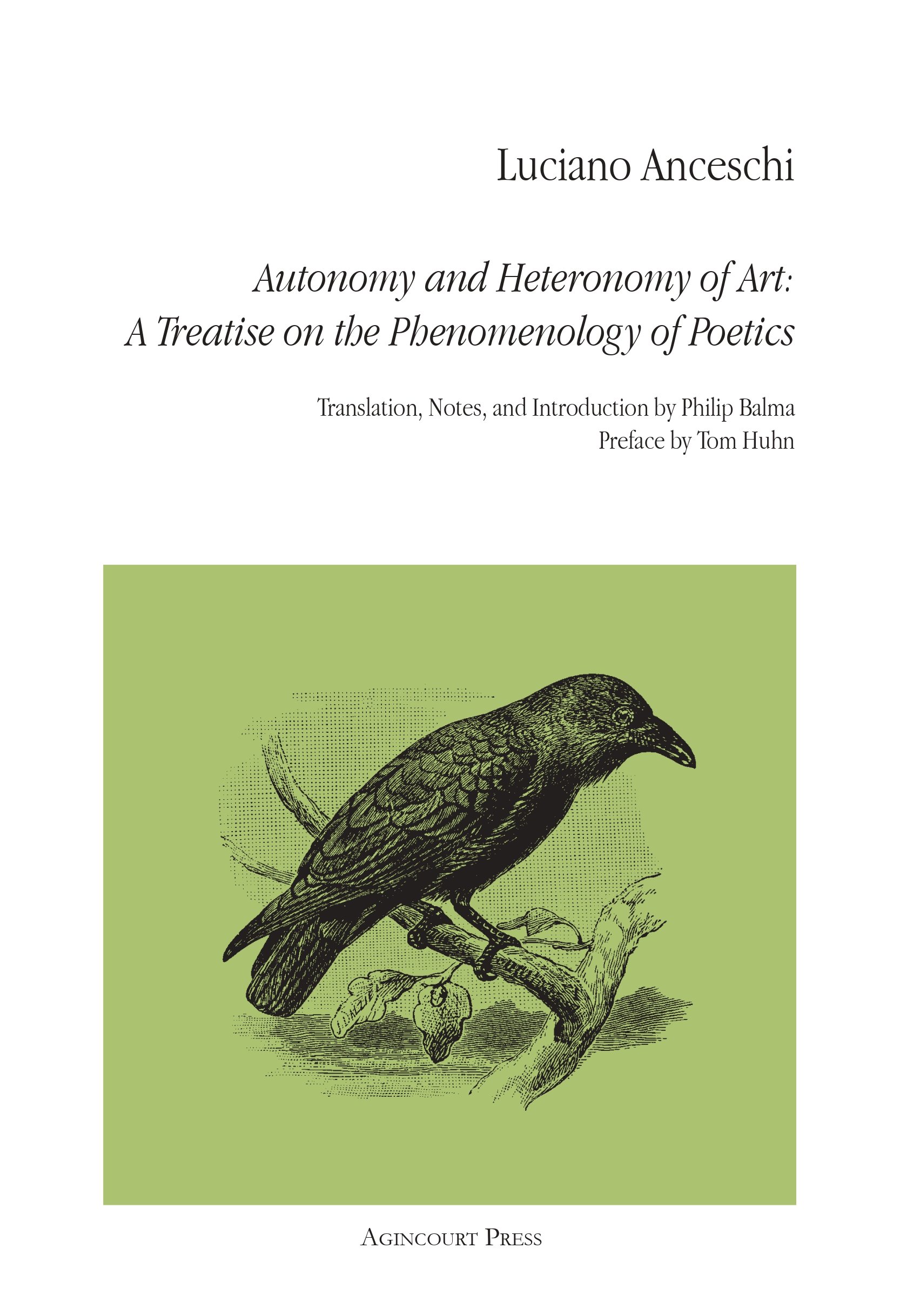
Luciano Anceschi
Philip Balma (Translator)
Description
Poetry finds its own reason to be and its own dignity within itself. It does this despite any evaluation of poetry in relation to its range, of any moralistic, pedagogical, or didactic purpose, or any moral, philosophical, or scientific content. Unbound by realism, naturalism, sensualism, or sentiment, looking beyond any concrete, defined content, or any dispersive tendency towards narrative or discourse, poetry disregards any evaluation that places its value in something extraneous.
“The impact and influence of Luciano Anceschi’s Autonomy and Heteronomy of Art: A Treatise on the Phenomenology of Poetics persists due to its rich and provocative ranging over a diversity of fields. The text formulates intriguing combinations of interpretation and insight that contribute to the disciplines of aesthetic theory, empiricism, phenomenology, literary theory, and poetics. Perhaps the book’s most enduring achievement lies in its demonstration that these fields overlap and interpenetrate one another.” — Tom Huhn, from the Preface
Luciano Anceschi (Milan, 1911 – Bologna, 1995) was a literary critic and aesthetic theorist, one of the leading exponents of Antonio Banfi’s “critical rationalism.” After earning a degree in aesthetics from the University of Milan, he published Autonomy and Heteronomy of Art (1936), a foundational text in his reflection on the theory of poetics. A university professor, he was the director of the journal Il Verri and a key figure in the debate on the neo-avant-garde. His extensive critical work profoundly influenced the study of literature and aesthetics in the twentieth century..
ISBN 978-1-946328-54-0